Specials
Daytona 16520 vs. 116520
Comparing the two Daytona generations: they look alike, but the pictures show the differences and also help spot fakes.

The Rolex Daytona is one of the most sought-after Rolex models (if you set aside a few vintage ones). Since it isn't easy to tell the two Daytona models 16520 and 116520 apart (and the similar other references in steel, yellow gold and white gold), they're compared side by side here in pictures. The comparison also makes it a bit easier to spot fakes, because many fakes (I'd guess well over 90%) simply mix features of both models. That said, there are now fakes that aren't that easy to spot.
To help you keep track, the pictures always show the "older" model, ref. 16520, on the left or on top, and the current Daytona, ref. 116520, on the right or on the bottom. Unless they're mine, the photos always come with a credit.
First, a few technical specs side by side:
| 16520 | 116520 | |
|---|---|---|
| Production | 1988 to 2000 | from 2000 |
| Caliber | 4030 | 4130 |
| Frequency | reduced from 36,000 bph to 28,800 bph | 28.800 A/h |
| Small seconds | at 9 o'clock | at 6 o'clock |
At first glance, the look of the watch hardly changed with the introduction of the new Rolex caliber. At second glance, though, there are some clear differences that let you tell the watches apart immediately. First, an overall view:
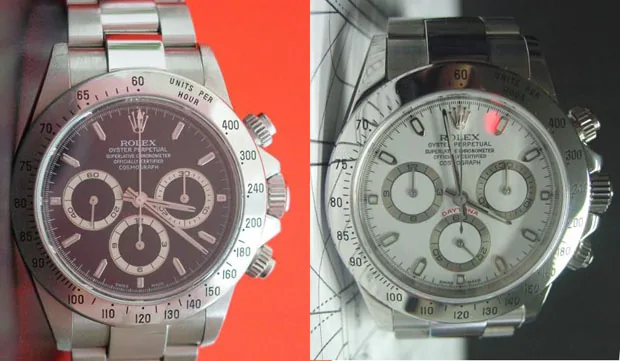
Here the differences are marked:

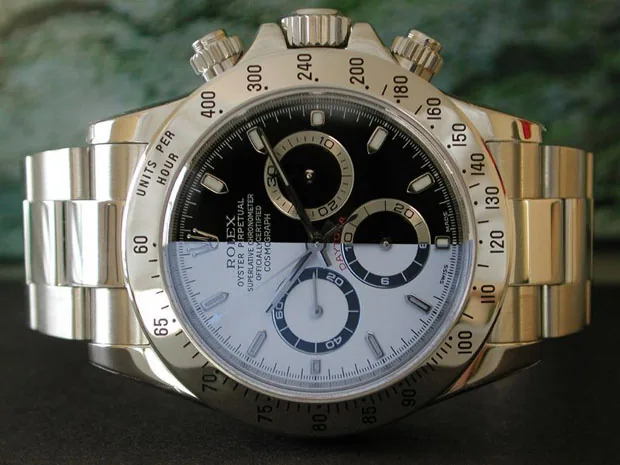
Dials
Here the 16520:

Here the 116520:
Movements
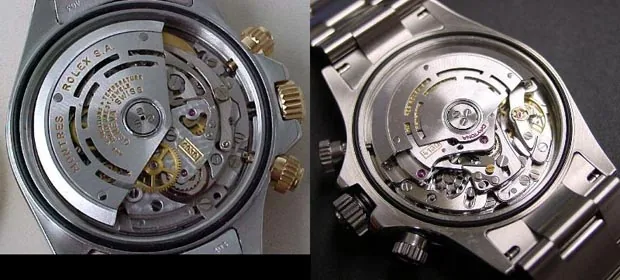
Case
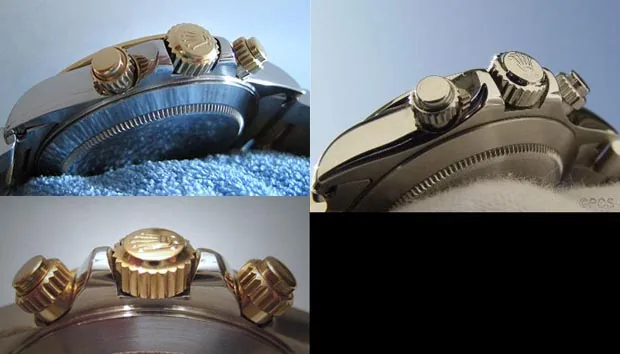
Pushers
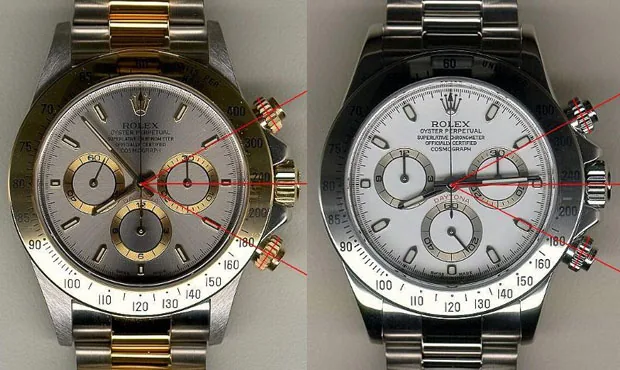
This contribution on the position of the pushers is by Matthias from the R-L-X forum and can be found in a thread there (in German). Because the topic is so interesting, I copied out Matthias's key points in full and unchanged, here in translation:
"The pushers of the 16523 (note: and so also the 16520) sit slightly 'crooked' in the case. The pusher axis doesn't form a right angle with the center line between pusher and the center of the watch. On the 116520 the pushers sit 'straight' in the case, and the pusher axis and the center line form a right angle. That the pushers are 'crooked' on the Zenith Daytonas can, by the way, also be seen well in Paddy's 16520 picture.
I suspect the reason is the caliber 4030, which is known to be based on the Zenith El Primero. Compared directly with my Zenith El Primero, you can see that the Daytona's pushers sit further up or down in the case than on the El Primero, because of the voluminous crown guards. The angle of the center line between pusher and watch center to the horizontal is slightly bigger on the Daytona than on the Zenith. For the pushers to still hit the actuation points in the movement exactly, the pusher axes of the Daytona had to be turned slightly. That's why the pusher sits 'crooked' in the case.
In the picture of the caliber 4030 movement you can see very nicely that the actuation points in the movement can only be hit because of the 'crooked' position of the pusher axes." (Matthias)
Very interesting. Until then, probably only a few people had noticed.
Clasp
The 116520 got a new, solid clasp compared to its predecessor. The Zenith model, on the other hand, has a stamped sheet-metal clasp, as known from the sports models (like the Submariner).

Bezel
Different bezels here. On the left this time the white gold model and on the right the steel version, both watches with caliber 4130.

Hands
Since the end of 2004, the steel models of the Daytona (116520) have wider hands. The hands match those of the white gold models.
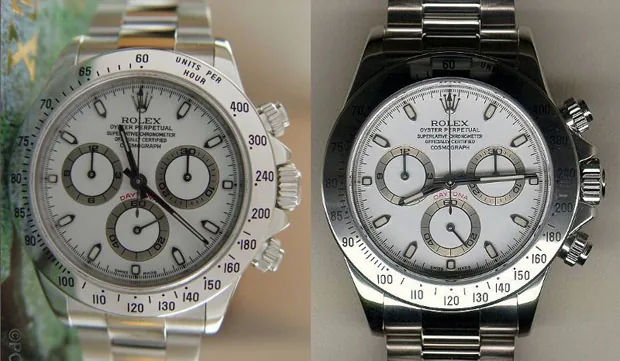
On the left the hands until the end of 2004, on the right from the end of 2004 (picture of a Daytona delivered on 11/29/04, serial no. F 708xxx)
Fakes
Here, for everyone considering buying a Daytona on the open market because of the supply situation, are some features of fake Daytonas. After studying the details above and these features, you should be able to recognize many of the fakes on the market:
Features
- Subdial lettering wrong
- Subdial rings too wide
- Bracelet brushing looks odd
- Hour markers much too wide
- Lume on the hands in the wrong place
- Hands too short/long
- Lower subdial with 24-hour display
Cover photo: © Rolex