Rolex History
The History of Rolex
From founder Hans Wilsdorf, born in Kulmbach in 1881, to the independent watch brand based in Geneva.

- 1881
Born in Kulmbach · Apprenticeship in La Chaux-de-Fonds
Hans Wilsdorf, the founder of Rolex, is born in 1881 in Kulmbach, Bavaria. At 19 he leaves home and moves to La Chaux-de-Fonds in Switzerland. At the well-known watch exporter Cuno Korten, he learns the practice of the watch trade. And this is exactly where the story of Rolex begins.
- 1905
Wilsdorf & Davis · London
Wilsdorf goes into business for himself and founds the company "Wilsdorf & Davis" with a partner in London, then the world's most important business and financial hub.
He has an idea that was unusual at the time: making wristwatches. Hans Wilsdorf foresees that the wristwatch will become practically indispensable in everyday life for men and women alike. As long as he can prove that it can be accurate, waterproof, rugged and reliable.

The Wilsdorf & Davis company sign. © Rolex - 1908
The "Rolex" brand
The idea goes over well and the business grows. In 1908 Wilsdorf registers the "Rolex" trademark. In doing so he breaks with the tradition that watch brands belong to the seller, not the maker. There are many rumors about how the name came about, none of which have ever been confirmed. Supposedly he went purely by these criteria, which still sound remarkably modern today:
- short, five letters at most
- easy to pronounce in any language
- pleasant sounding
- easy to remember
- looks good on the dial and the movement of a wristwatch
- 1915
Move to Bienne · 1919 to Geneva
Wilsdorf moves his company to Bienne to avoid import duties. In 1919 he finally relocates the company headquarters to Geneva and founds Montres Rolex S.A., which still exists today. The international appeal of the city, which itself looks back on a very old watchmaking tradition, plays a big part in this decision. From then on the cases are made in Geneva, while the movements are still made in Bienne. Movement and case are married in Geneva, so the watches are completely "Swiss made".
Over the following years, Rolex keeps developing its movements and builds them with great effort and at a high level of quality. New products are brought to series production and revolutionize the watch world.
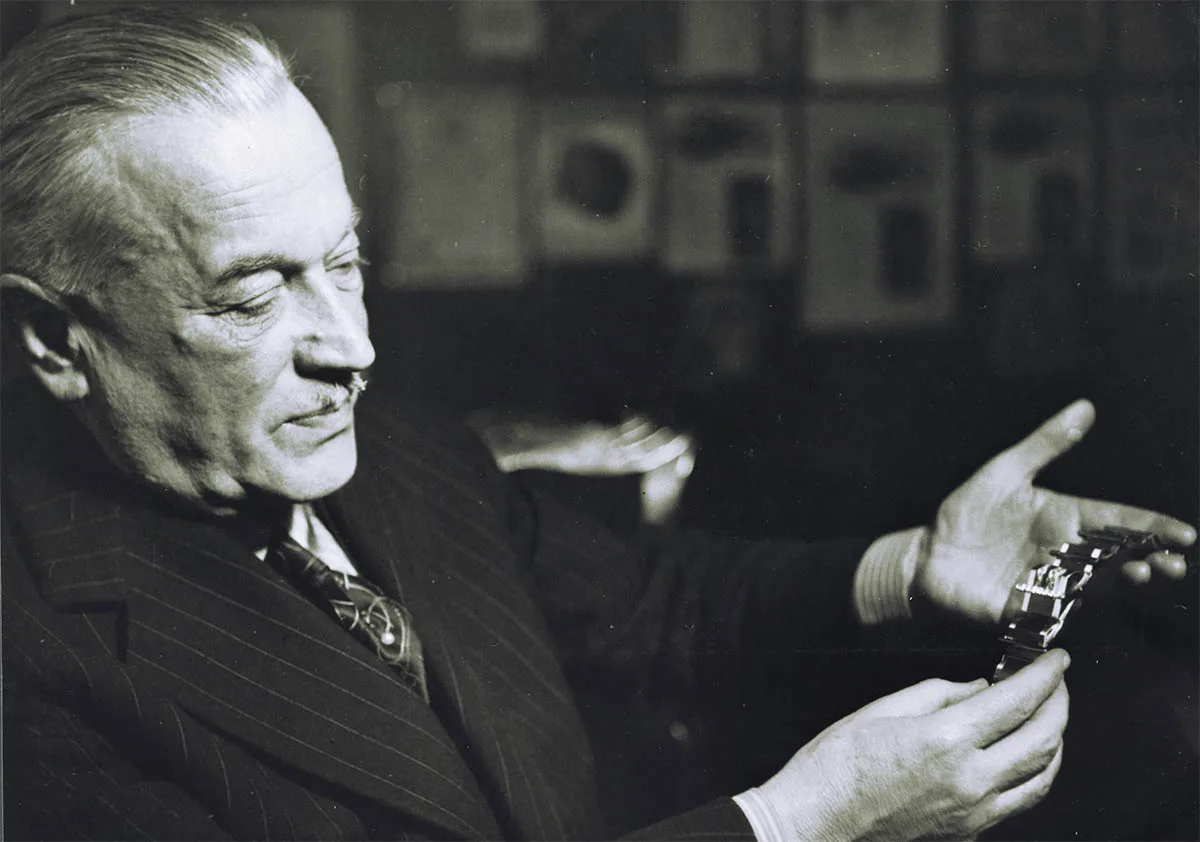
Hans Wilsdorf. © Rolex - 1926
Oyster · the first waterproof wristwatch
Hans Wilsdorf's efforts to achieve absolute water resistance succeed with the Rolex Oyster, the world's first waterproof wristwatch. The system, patented by Rolex, has a bezel, a case back and a winding crown that are hermetically screwed down onto the middle case. That's where the typical Rolex look comes from to this day: the fluting on the bezel and case back was there so the components could be screwed onto the middle case with a special key developed by Rolex. Today the bezel is no longer screwed to the case, but as a nod to the past you still find the fluting on some Rolex watches.
- 1927
Mercedes Gleitze · English Channel

The Daily Mail with the ad for the Oyster, 1927. © Rolex Hans Wilsdorf comes up with the idea of putting the Oyster through a "trial by fire". The young English swimmer Mercedes Gleitze crosses the English Channel with an Oyster on her wrist, and the watch stays dry. To celebrate this feat, Hans Wilsdorf runs a full-page ad on the front page of the Daily Mail.
- 1931
Perpetual · rotor self-winding
Rolex develops the first rotor-driven self-winding mechanism for wristwatches. It consists of an oscillating weight that rotates freely around its axis in both directions. This way the movement is wound constantly just by the motion of the wrist. A revolution in the watch world.
- 1945
Datejust · Hans Wilsdorf Foundation
The Oyster Perpetual Datejust comes onto the market, the world's first automatic, waterproof, chronometer-certified wristwatch that shows the date in a window on the dial.
After 1945, Wilsdorf turns to a new project. He steps back from running the company more and more and founds the "Hans Wilsdorf" Foundation for scientific and charitable purposes. But the developments he started continue and go into series production.
- 1953
Mount Everest

Illustration from a 1953 Everest supplement. © Rolex Sir Edmund Hillary and Tenzing Norgay, members of a British expedition led by Sir John Hunt, are the first to reach the summit of Mount Everest. The expedition is equipped with Rolex Oyster Perpetuals, which hold up against the harsh conditions like the extreme cold and the air pressure.
- 1956
Day-Date
Rolex introduces the Oyster Perpetual Day-Date, the first wristwatch that shows not just the date but also the day of the week, fully spelled out, in a window on the dial.
- 1960
Wilsdorf dies · Cosmograph
Hans Wilsdorf dies at age 79. The success continues after him, though: that same year Rolex introduces the Cosmograph, which later becomes the Daytona.
- 1965
NASA tests · Speedmaster instead of Rolex
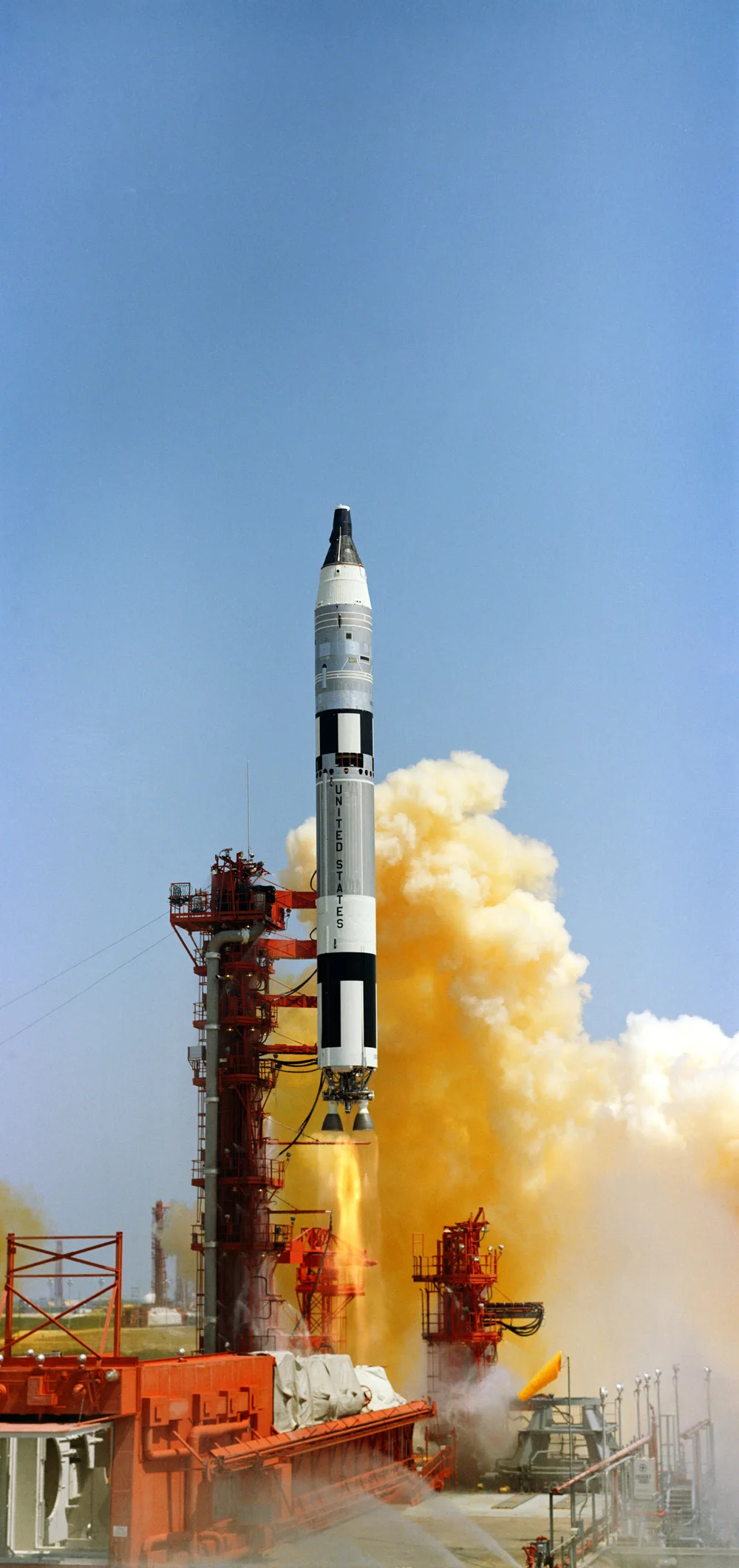
Launch of Gemini 4 on June 3, 1965, at Cape Kennedy. © NASA Not every story at Rolex is a success story. On September 21, 1964, Deke Slayton, the head of flight crew operations at NASA, noted internally that the Gemini and Apollo crews needed an especially rugged and accurate chronograph. The astronauts had asked for one themselves. NASA engineer James Ragan then sent a request for quotation to about ten watch manufacturers, including Omega, Rolex, Longines and Lucien Piccard.
Only four manufacturers responded: Rolex, Longines-Wittnauer, Hamilton and Omega. Hamilton was out right away because the company sent a pocket watch instead of a wristwatch. So three chronographs were tested: the Longines-Wittnauer 235T, the Rolex 6238, a precursor of the Daytona, and the Omega Speedmaster 105.003. The Rolex and the Longines-Wittnauer ran on a Valjoux 72, while the Speedmaster used the caliber 321.
NASA put each watch through eleven tests. They included heat of 70 degrees Celsius for 48 hours and then 93 degrees in a partial vacuum, cold of minus 18 degrees, humidity above 95 percent, corrosion, six shocks of 40 g, acceleration up to 16 g, low and high pressure, vibration and a noise test at 130 decibels. After the tests, a watch could deviate by six seconds per day at most, on average.
According to documents from the Omega archive that Fratello Watches has seen, the Rolex 6238 failed the humidity test, and the movement simply stopped. It also failed the heat test. The Longines-Wittnauer failed the heat test as well, when its crystal warped and came loose. Only the Speedmaster passed every test, though not unscathed: the luminous material on the hour markers suffered, and decompression and acceleration affected the rate.
The tests ended on March 1, 1965. On March 23, 1965, the Speedmaster 105.003 flew into space on the wrists of Virgil Grissom and John Young, and on June 1, 1965, it received NASA's approval for all manned missions. Strictly speaking, that was a qualification and not a certification, because NASA doesn't certify anything. Two days later, on the Gemini 4 flight during the first American spacewalk, Ed White wore two Speedmasters over his spacesuit.
For Rolex this was a setback, and the moon missions went to Omega. Still, Rolex was one of the three manufacturers that made it to the testing with a chronograph.
- 1978
Everest without oxygen · Oysterquartz
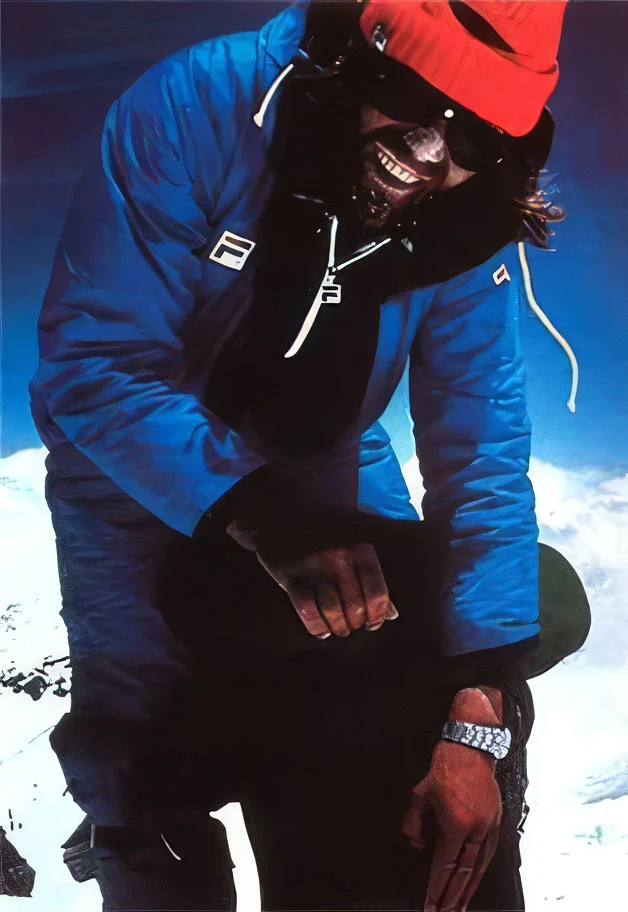
Reinhold Messner. Reinhold Messner climbs Mount Everest with Peter Habeler without supplemental oxygen, wearing a Rolex Oysterquartz.
- 2000
In-house chronograph caliber · independent
With its own chronograph caliber in the Daytona in 2000 and the gradual takeover of all its suppliers, Rolex has since become completely self-sufficient and no longer depends on other companies. Quite the opposite: Rolex is one of the few big watch brands that doesn't belong to one of the large groups.
- Today
One of the best-known watch brands
Rolex is now one of the best-known brands in the watch world and is valued by wearers, connoisseurs and collectors. You can see it in stable prices and, for vintage watches, sometimes sharp price jumps upward. Rolex is also one of the few brands whose watches stir emotions, because almost everyone dreamed of owning a Rolex as a kid.
Cover photo: Rolex Geneva © Rolex/Cédric Widmer.
The 1965 chapter is based on the reports "Watches & Pencils #21: The NASA Tests and the Speedmaster" (2016) and "How The Omega Speedmaster Became The Moonwatch" by Fratello Watches (fratellowatches.com).